Crushing and Grinding Equipment & Complete Production Lines
Configure crushing, grinding, and feeding equipment in stages based on material hardness and target particle size, processing feed from 1350 mm down to 0-5 mm finished sand.
- Gyratory crusher capacity
- 300–5000 t/h
- Cone Crusher Capacity
- 6–2750 t/h
- Ball mill capacity
- 0.65–614 t/h
- Aggregate production line design capability
- 17000 t/day
Our News
All News17000 TPD Granite Aggregate Production Line: Analysis of Four-Stage Crushing Equipment Configuration
11 9, 11:16How to Match Discharge Size with Motor Power: 6 Common Data Mistakes in Selecting Compound Cone Crushers
11 9, 13:23How 1350mm Feedstock Becomes 1–5 mm Finished Product: Configuration Logic for an Aggregate Line
Engineering Implementation Capabilities

Four-segment fragmentation configuration
1350 mm granite feed with four-stage crushing and interstage screening to consistently produce 0-5, 5-10, 10-20, and 16-31.5 mm aggregates.

Closed-circuit screening process
Oversized material is returned to the previous stage. The crusher processes only material that truly requires crushing, reducing unnecessary fragmentation and oversized finished particles.

Continuous operation in low-temperature mining areas
In high-latitude mining areas, winter temperatures are low and logistics cycles are long. Local offices conduct scheduled inspections, replace worn parts, and ensure spare part supply.
Selection Criteria and Calculation Methods
Throughput for the same unit can vary by over 30% depending on parameter definitions, primarily due to differences in discharge opening, chamber type, and rated conditions. The following specifications align with manufacturer data sheets and serve as our standard baseline for process calculations.
Four Key Metrics
- Chute (CSS) refers to what?
- Minimum gap at the closest point between the cone and the mantle, in millimeters. The Open Side Setting (OSS) refers to the gap when the cone is retracted to its farthest position; the difference between OSS and CSS can exceed double. If the size is not specified in the parameter table, verify against the Closed Side Setting (CSS).
- How is the crushing ratio defined?
- Ratio of maximum feed size to discharge opening. For single-stage cone crushing, the reduction ratio is typically 3 to 8. Exceeding this range requires additional crushing stages; otherwise, both flaky/elongated particles in the product and circulating load will increase. Refer to the applicable ranges for each chamber type.PYS Series Composite Cone Crusher Specifications。
- What is circulating load?
- In a closed-circuit process, the ratio of oversize return to new feed typically ranges from 50% to 150% in aggregate lines. When screening efficiency drops, this ratio increases, and equipment throughput is reduced due to recirculating material.
- What is the Bond Work Index (Wi)?
- A metric indicating the ease of ore comminution, measured in kWh/t, used for calculating mill power and steel ball consumption. A one-level difference in Bond Work Index between similar mines can result in over 20% variation in mill throughput. Mill power and production parameters are shown below.Ball Mill Product Page。
Four-step calculation sequence
- Finished Product:Determine screen aperture size and oversize control points based on the finished product particle size distribution curve, then back-calculate discharge settings for each section.
- Calculate reduction ratio:Divide the maximum feed size by the target discharge setting. Use segmented configuration when the ratio falls outside the 3 to 8 range. See [link] for derivation of segmentation methods matched to cavity types.Six Data Myths in Selecting a Compound Cone Crusher。
- Select Cavity Type:Select standard, medium, or short-head cavity types from the manufacturer's cavity chart based on the crushing ratio and feed gradation. Refer to the cavity configuration table below.S Series Compound Cone Crusher。
- Calibration Power:Allow for a 10% to 15% margin based on shaft power. Additional derating calculations are required at altitudes exceeding 1000 meters or when ambient temperatures are high.
Data Source and Calibration Conditions
- Capacity range sourced from various seriesProduct SpecificationsCalibrated for open-circuit crushing of medium-hardness materials.
- Process calculations are based on feed gradation sieve analysis, ore loose density, and Bond work index test data.
- Post-commissioning validation is based on three field data points: operating current, actual discharge gap, and finished product sieve analysis.
- Production capacity and granularity in the case study are project acceptance records, anonymized with client authorization before publication.
Case Studies
View more case studiesComplete line project configured based on feeding conditions, finished product specifications, and operating environment, including issues, solutions, and operational results.

Ore, MetallurgyChengde, Hebei
Chengde Jianlong 2000 ton/hour primary crushing and grinding equipment
- Issue
- Iron ore and metallurgical auxiliary materials are processed at the same plant. Due to the wide range in feed size and product fineness, crushing must seamlessly transition into grinding.
- Solution
- Primary crushing with gyratory crushers, secondary and fine crushing with cone crushers, and grinding in ball mills. Screening and transfer equipment are installed between stages, with oversize material recirculated in a closed circuit.
- Results
- The entire line operates at 2000 tons/hour, ensuring stable load distribution between crushing and grinding while reducing spare parts variety and maintenance workload.

Building materials, new materials· Huizhou, Guangdong
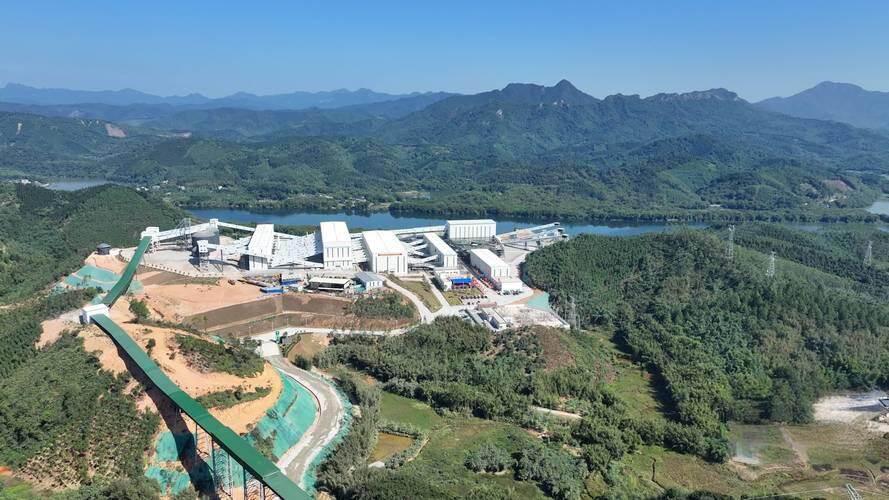
Sand and gravel aggregate crushing equipment, Huizhou, Guangdong 17000 tons/day
- Issue
- Granite has a Mohs hardness of 6-7, with raw ore diameters up to 1350 mm. Four finished product specifications must be produced simultaneously.
- Solution
- Four-stage crushing: PXZ1600 gyratory crusher paired with HG710B and HG450D multi-cylinder hydraulic cone crushers, with intermediate screening and closed-loop return.
- Results
- Daily capacity: 17000 tons; stable output of 0-5, 5-10, 10-20, and 16-31.5 mm aggregates. Second and third stages share the same model with different chamber configurations for interchangeable spare parts.